
Some early-stage founders think high availability is something you earn after product–market fit. The logic sounds reasonable: “We only have 1,000 users. If a server dies, we’ll restart it.”
That mindset is expensive.
In 2026, reliability isn’t a luxury feature. It’s part of the product. Users don’t care that you’re a startup. They care that your app works when they need it. And if your platform goes down during a paid campaign, an investor demo, or a high-traffic launch, the cost isn’t just lost requests—it’s lost trust.
This is why Multi-AZ architecture on AWS isn’t overkill. It’s how you avoid building your company on a single point of failure.
The Myth of “Too Small to Fail”
Downtime hits smaller teams harder because you’re usually operating with thin margins: fewer engineers on-call, less time to debug, and less tolerance for public failures.
A single outage can trigger a chain reaction: support tickets, churn, refund requests, angry users on social, and a demoralized team that spends the next week patching instead of shipping. And the worst part? Many outages aren’t caused by “big” problems like bad deployments. They’re caused by ordinary infrastructure events that happen to everyone—hardware issues, networking failures, and zone-level incidents.
If your stack lives in one Availability Zone, you’re betting your business that nothing bad happens in that one place.
What “Multi-AZ” Means in AWS
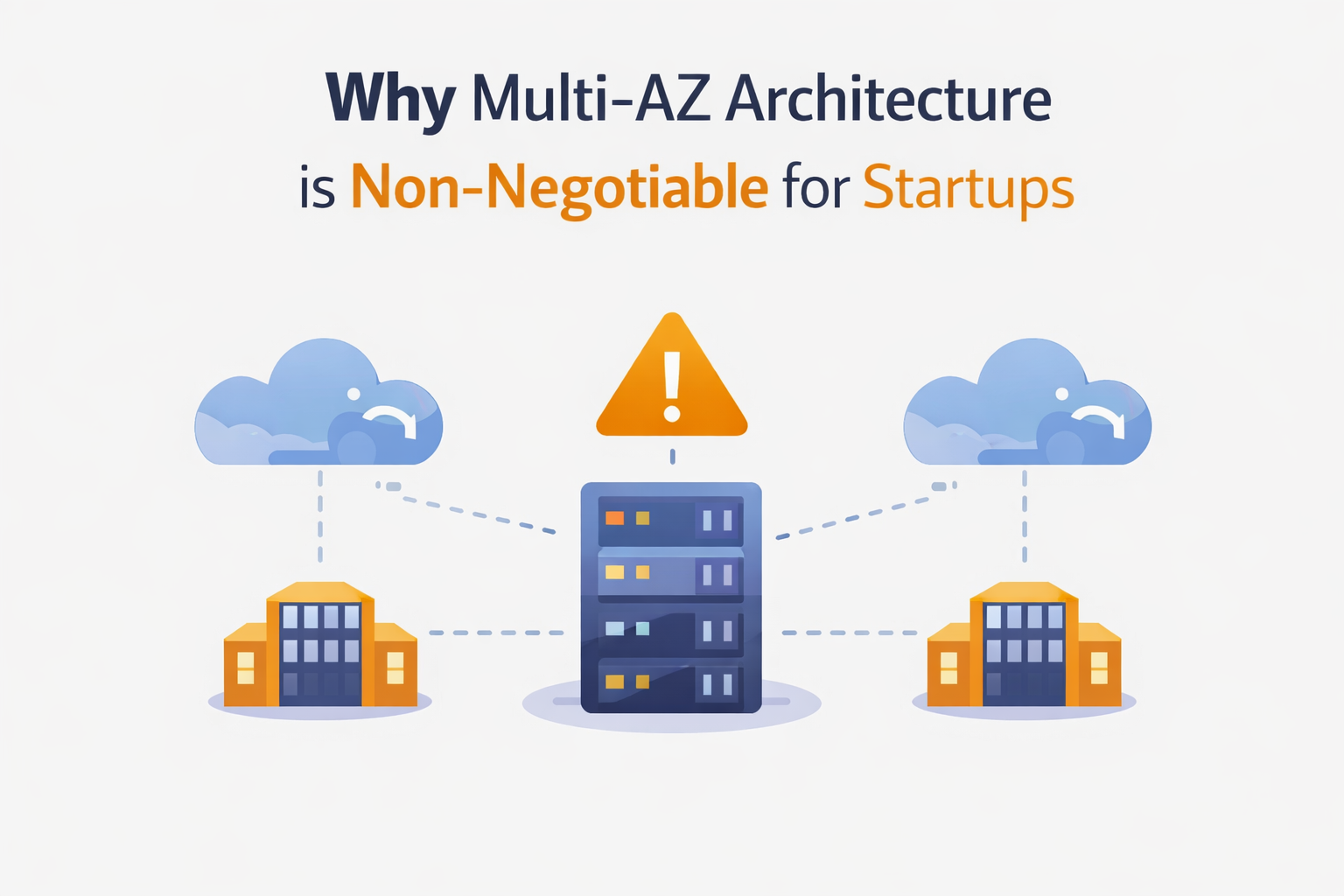
AWS is built around Regions (for example, eu-west-1 or us-east-1). Each Region contains multiple Availability Zones (AZs)—separate, isolated data centers with independent power, cooling, and networking.
That isolation is the whole point: an AZ can fail without taking the entire Region down.
But if you deploy your app into a single AZ—your EC2 instance, your database, or your critical networking—your uptime is only as strong as that one zone. When that zone has problems, your service goes with it.
Multi-AZ means your system is designed to survive losing an AZ without going offline.
Why Single-AZ Fails in the Real World
When people hear “high availability,” they imagine rare disasters. In practice, the failure modes are boring—and that’s exactly why they’re dangerous. You can be taken down by a transient network issue, a noisy hardware failure, or a partial dependency disruption that only affects one zone.
If your load balancer, compute, or database can’t tolerate that event, your “small” system still goes dark.
High availability isn’t about dramatic catastrophes. It’s about removing fragile assumptions.
The Practical AWS Pattern: Active-Active Across Two AZs
For most startups, you don’t need a complex multi-region setup to be resilient. You need a clean, boring baseline that can take an AZ hit and keep serving traffic.
On AWS, the common approach is an active-active design across at least two AZs:
Your traffic enters through an Application Load Balancer (ALB) that routes requests only to healthy targets. Behind it, an Auto Scaling Group runs instances in multiple zones so capacity stays available even if one zone degrades.
For data, RDS Multi-AZ is the default move for production workloads. It synchronously replicates to a standby in another AZ and can fail over when the primary becomes unhealthy. You’re not designing a distributed database from scratch—you’re buying reliability with a managed primitive.
The result is simple: if one AZ goes dark, the system keeps breathing while you troubleshoot. That’s the difference between a scary dashboard and a public incident.
Cost vs. Value: The Startup Math Nobody Wants to Do
Yes, Multi-AZ typically costs more. If you run two instances instead of one, your compute line item increases. But the absolute difference for many early products is smaller than people expect—often the jump is from “cheap” to “still cheap,” especially compared to the cost of downtime.
Here’s the question that matters:
If your product is unavailable for an hour during your most important moment this month, what does that cost you—in revenue, trust, and momentum?
When you price Multi-AZ against the downside, it’s rarely an infrastructure decision. It’s a business decision.
The Baseline We Recommend at Good2Cloud
At Good2Cloud, we treat Multi-AZ as the default, even for MVPs, because availability is easiest to implement early—when the system is still simple. Retrofitting resilience later is when it becomes painful and expensive.
If you’re building on AWS and you want a production-ready foundation that won’t collapse the first time a zone has a bad day, Multi-AZ is the starting line—not the finish line.
If you want, I can also rewrite this into a WordPress-friendly structure (intro + short paragraphs + H2/H3 rhythm + CTA), and suggest a SEO title + meta description to push that score above 70.