
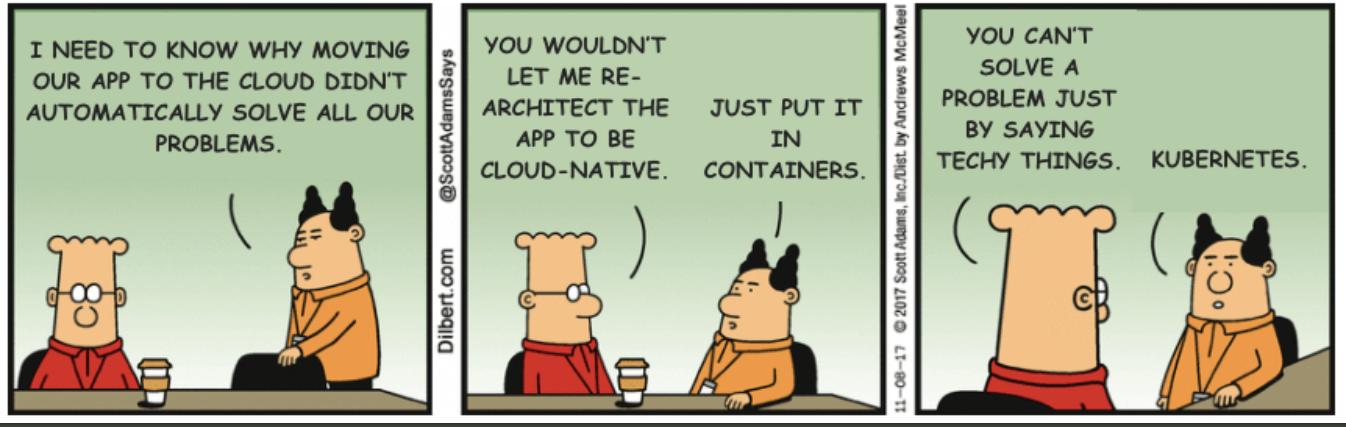
Kubernetes has become the default answer to almost every infrastructure question. «Need scalability? Kubernetes.», «High availability? Kubernetes.», “Modern DevOps”? Kubernetes. But the first answer people usually forget is Do I need Kubernetes?
At this point, it feels like not using Kubernetes means that we’re doing something wrong.
Before creating (and maintaining) a Kubernetes cluster, the most important question to ask ourselvers and the first one we should answer is:
Do I really need Kubernetes right now?
For many small companies, startups, and early-stage products, the simple answer is no.
And that’s not a failure. It’s often the most strategic (and intelligent) Infrastructure decision you can make.
Kubernetes Is a Tool, Not a Goal
Kubernetes is a very powerful platform, but it isn’t an objective by itself. It’s a tool. Like any tool, its value depends entirely on the problem you’re trying to solve. You should analyze if there are other options that fit better with your requirements.
Before choosing the platform where your services are going to run, ask yourself:
- What problems are we facing today?
- Are deployments slow, painful, or unreliable?
- Are we struggling with scaling or availability?
- Do we have clear operational bottlenecks Kubernetes would solve?
If your application is stable, the traffic is predictable, and deployments are already automated, Kubernetes may provide little immediate value. In many cases, a simpler cloud infrastructure can meet your needs with less effort (and probably less cost).
Kubernetes Offers More Features… and More Complexity
There’s no doubts what Kubernetes will provide:
- Auto-scaling
- Self-healing workloads
- Service discovery
- Declarative infrastructure
- Advanced networking and security primitives
But everything in life comes with a cost.
Running Kubernetes means dealing with:
- Cluster, node, and upgrade management
- YAML and configuration drift
- Complex networking and storage models
- Debugging distributed systems issues
- A steep learning curve for the entire team. It is a new abstraction layer you need to learn.
Even with managed Kubernetes services as EKS in AWS or GKE in GCP, a large operational work is still needed. More features inevitably mean more things that can break, and more time spent maintaining infrastructure instead of building product, which should be your priority.
This is where Kubernetes very often becomes overkill for small teams.
Why Kubernetes Complexity Is a Business Risk
Complexity isn’t just a technical concern, it’s a business risk.
A complex platform:
- Requires specialized and expensive expertise.
- Increases onboarding time for new engineers.
- Makes incidents harder to diagnose and resolve.
- Raises the probability of misconfigurations and outages.
- Could increase hidden costs.
For small or medium teams, Kubernetes can quietly become a single point of failure. Not because it’s unreliable, but because the team isn’t fully prepared to operate a Kubernetes cluster with confidence.
When your infrastructure is harder to understand than your application, you’ve introduced risk that may not be justified by your current business needs.
You Probably Don’t Need All Those Kubernetes Features (Yet)
Kubernetes is a perfect option for large-scale, highly dynamic, multi-service environments. But most applications don’t start there.
In an early stage, you may not need:
- Multi-region orchestration
- Complex auto-scaling policies
- Advanced traffic routing
- Fine-grained resource scheduling
Instead, alternatives to Kubernetes such as:
- Managed PaaS platforms
- Container services without orchestration overhead
- Virtual machines with simple deployment automation
can offer:
- Predictable behavior
- Faster time to market
- Lower operational burden
- Easier troubleshooting
And here’s the key point many teams miss: You can always migrate to Kubernetes later.
Going back to the initial question of «Do I Need Kubernetes?». The answer is probably not yet.
Adopting Kubernetes when the need is real is easier than surviving it when it isn’t.
Do I Need Kubernetes? Or what do I need?
Will Kubernetes give you best-in-class scalability? Probably.
Will it be cost-efficient at massive scale? Often yes.
But most startups and small companies don’t need perfection on day 1.
What you do need is:
- A reliable platform.
- Reasonable scalability.
- Clear operational visibility.
- Infrastructure your team fully understands and can debug it in case of outage.
A simpler DevOps setup may not optimize every metric, but it can meet all your current requirements while keeping cost, risk, and cognitive load under control.
That’s building sustainably, and it’s the best DevOps decision you could take.
When You Do Need Kubernetes
To be clear, Kubernetes is an excellent platform when the timing is right.
You’re more likely ready for Kubernetes if:
- You’re running many services with independent scaling needs.
- Traffic patterns are unpredictable and highly variable.
- Your team has strong DevOps/SRE experience.
- Infrastructure automation is already mature.
- Operational complexity is your main bottleneck.
At that point, Kubernetes starts being the perfect match for your requirements.
Final Thoughts: Do I Need Kubernetes? Probably not yet
Adopting Kubernetes too early can slow teams down, increase operational risk, and distract from what matters most: delivering value to customers. You will have the most fancy and latest tools and you could probably write a LinkedIn post showing your cool infrastructure.
The most mature DevOps decision isn’t always choosing the most powerful tool, it’s choosing the simplest solution that reliably meets your needs today.
Ask the hard question first.
Build what your business actually needs right now.
And when Kubernetes truly makes sense, you’ll be ready to adopt it successfully.
Sometimes, the best DevOps decision is knowing when not to use Kubernetes. At good2cloud, we will always help you asking yourself the correct questions.