
The «ClickOps» Trap
It usually starts with speed, not recklessness.
You need an S3 bucket, so you jump into the AWS console, hit “create,” tweak a couple of settings, and move on. No ticket, no review, no waiting. For an early team trying to ship, that feels like progress.
The problem is that the console is great at creating resources, but terrible at preserving intent. Six months later, the questions show up like clockwork:
Who changed that security group rule?
Why is staging behaving differently than production?
How did we configure the VPC when we expanded to a new region?
This is technical debt, but it’s a particular kind: invisible, undocumented, and operationally expensive. Clickops doesn’t fail on day one. It fails when you need consistency, repeatability, or confidence under pressure.
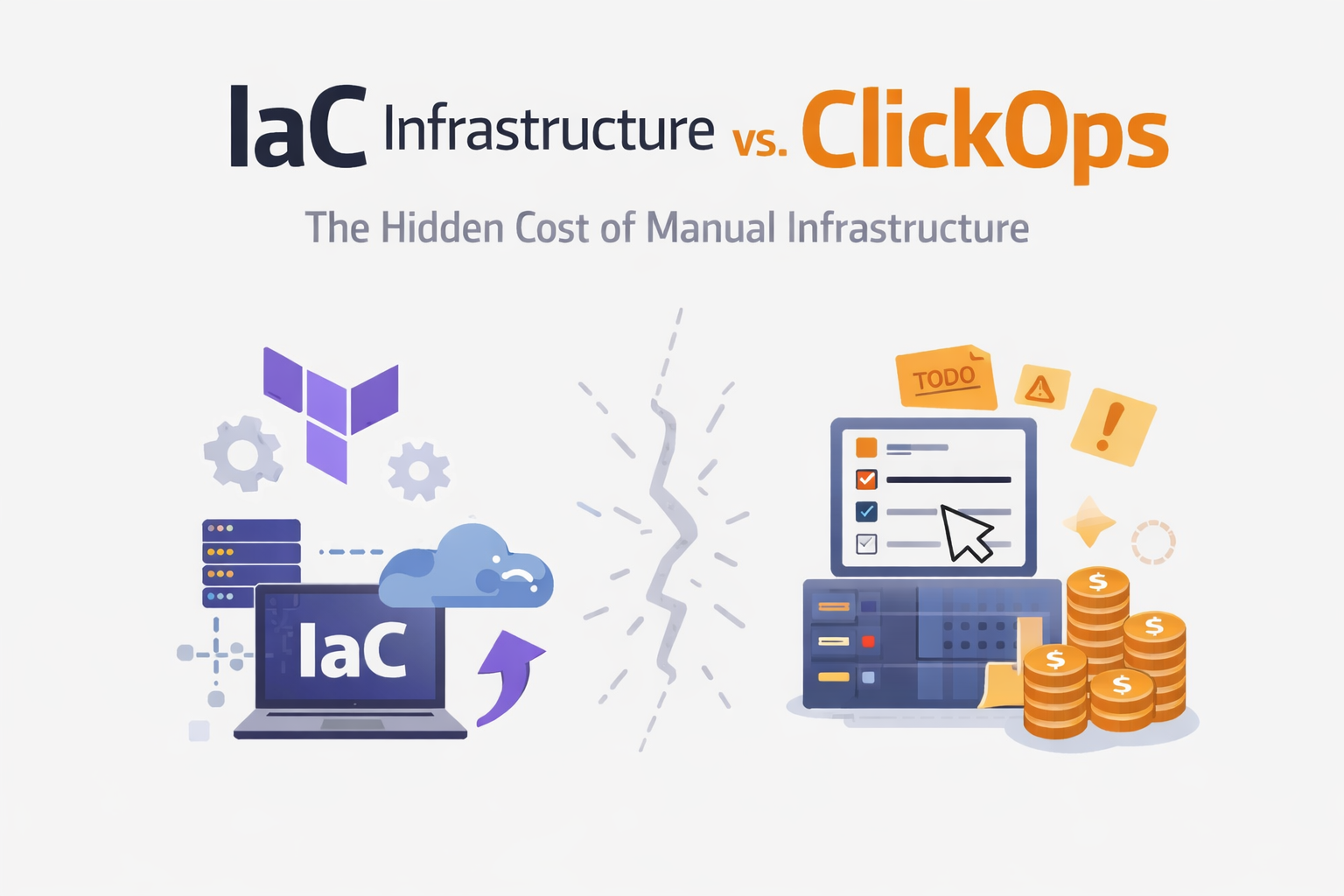
What ClickOps really costs
Manual infrastructure has a hidden tax that grows over time.
First, it creates configuration drift. Two environments that started “the same” slowly diverge as people click different options, follow different habits, or fix issues with one-off tweaks. That drift becomes the root cause of many incidents, because you stop being able to reason about what’s deployed.
Second, it kills traceability. In the console, you can often see that a change happened, but not the full story of why, what it replaced, or what else should have been updated with it. When something breaks, you end up doing archaeology instead of engineering.
Third, it slows down scaling. The more you grow, the more infrastructure becomes a product in itself: new accounts, new regions, replicated environments, compliance requirements, reliable rollbacks. Clickops turns all of that into a manual checklist, which means delays, mistakes, and stress.
Enter Infrastructure as Code (IaC)
Infrastructure as code means your AWS resources are defined in version-controlled files, reviewed like application code, and applied consistently through automation.
Instead of “we clicked until it worked,” you get “this is the exact desired state, and we can reproduce it anytime.”
Terraform is a common tool for this, but the bigger concept is what matters: your infrastructure becomes readable, repeatable, and reviewable.
Here’s a simple example of declaring an S3 bucket in code:
resource "aws_s3_bucket" "app_data" {
  bucket = "my-startup-data"
  acl    = "private"

  versioning {
    enabled = true
  }
}
The value isn’t the syntax. The value is that this bucket configuration stops living in someone’s memory and starts living in your system of record.
Why teams switch sooner than they planned
Disaster recovery gets real the moment something goes wrong. If an AWS account is compromised, or a critical resource is deleted, the question isn’t “can we rebuild it eventually?” It’s “can we rebuild it fast, correctly, and under pressure?” With infrastructure as code, rebuilding is a controlled process, not a scramble to remember every setting.
Auditability becomes automatic. When infrastructure changes are driven through Git, you get a clean history of who changed what, when, and what else was part of the same change. That turns debugging into reading diffs instead of chasing console screenshots.
Environment parity stops being a dream. Dev, staging, and production can be generated from the same modules and patterns, with only intentional differences. That’s how you avoid the classic trap where staging is “close enough” until it isn’t.
The real win: infrastructure you can trust
Clickops optimizes for speed in the moment. Infrastructure as code optimizes for speed over time.
It reduces outages caused by drift, makes changes safer through review, and turns scaling into replication instead of reinvention. You ship faster because you spend less time guessing and more time executing.
If you want, I can adapt this into a more SEO-driven version (same tone, no heavy bulleting) by adding: a stronger meta description, a short FAQ section (“is clickops ever ok?”, “terraform vs cloudformation”), and internal link anchors for WordPress.